







Buffalo King Megaways Slots Review
Practical explanation for 2026: discover playing, betting, limits, and payouts of Buffalo King Megaways in Netherlands.
Buffalo King Megaways Slot Review: What You See In Netherlands
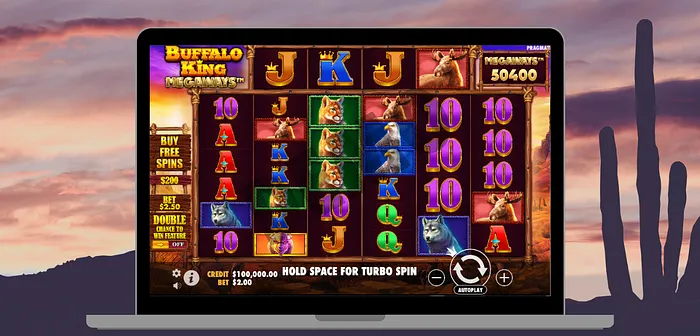
Buffalo King Megaways feels like a slot that immediately forces you to make choices about pace and stakes. Not because you have many buttons, but because the game rhythm can become fast if you use automatic functions. In Netherlands, you usually encounter this title in the slot overview of online casinos accessible in your region, and then the first step is not “going hard,” but orienting yourself: where do you find the game explanation, how do you adjust the bet, and how do you set a pause or limit before you get into the flow. It helps to keep the Megaways principle simple: the number of symbols on the reels can differ per spin, allowing you to experience payouts in waves. That is normal.
Imagine that after a long day you want to relax and you choose the fastest setting because it feels “nice and quick.” Usually, players only notice after a few minutes that quick also means you can run through your budget faster. By consciously starting slowly, you give yourself space to read the game instead of just reacting.
All promotional incentive structure is clearly stated in writing and/or via electronic means in an easily understood manner. All codes are accompanied by an explanation of what the code is for, who is eligible to use the code, and how it should be used. As such, players are less likely to be confused about what is required of them in order to receive a reward and how the reward will be applied after receiving it. The promotional incentives provided to participants provide them with time to become familiar with the gaming system's mechanics, their interface, and progress, before deciding how deeply they wish to become involved with this platform. Therefore, players are encouraged to participate in an informed manner, rather than being pressured or tempted to act quickly.
Buffalo King Megaways Review: Features And Gameplay
A useful review starts with what you actually experience on the screen. First, look at the basics: are the bet steps clear, do you immediately see your balance and win notifications, and can you easily return to settings without searching? Only then do you pay attention to the extras: moments when the reels react differently, when you see special symbols, or when the game pulls you into a clear “phase”. Many players make the mistake of immediately focusing on “when will the bonus come”, but you benefit more from understanding the tension in the game: how often does something small happen, how long can quiet streaks last, and how does that feel at your pace and budget?
If you play on mobile, readability is extra important (especially if you are on the go). Imagine you are on a train and your screen brightness is low. Usually, players click faster then and miss information such as bet level or auto-settings. Take 30 seconds to set your screen and speed correctly, then you will play more calmly and make fewer sloppy choices.
Game Start And Settings For A Calm Session
Start with a short exploration before you “really” play. Set sound and speed to your level, open the game explanation, and check what automatic options exist (such as a series of spins or a stop on win or loss, if the casino supports that). Then choose a starting bet that matches your session budget, not the excitement of the moment. If in doubt, start lower than your instinct tells you. A low bet is not a lack of courage, but a way to feel the variation without every spin feeling heavy. In Netherlands it is extra wise to play in advance within the applicable rules and only if you are of legal age, with limits that you truly accept.
Imagine you “just” start without a plan and after ten spins you see that you have already adjusted three times. Usually, that is a sign that you have no anchor. Therefore, make one simple agreement with yourself: first a fixed series at the same bet, only then evaluate.
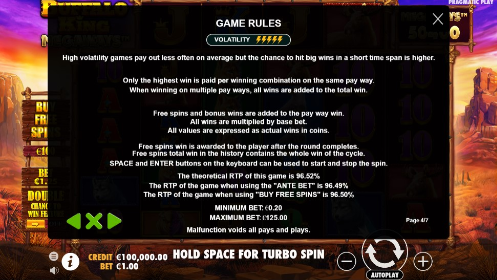
Buffalo King Megaways RTP: How To Read It
The payout percentage is useful, but you use it best as context, not as a prediction. See it as a theoretical ratio over many spins: it says something about the design, not about your short session. In practice, the variance mainly determines how your balance moves. Sometimes you feel a series of small repayments, sometimes you are in a longer quiet phase where you are mainly managing: pace down, bet stable, and not increasing “after your feeling”. Try to approach it this way: your goal is a session that you control, not a number that controls you.
If you notice that you immediately draw conclusions after a few losing spins, pause. Imagine you hear yourself thinking: “this is not going to work today.” Usually, that is not based on information, but on emotion. By slowing down for a moment and checking your plan, you make the game a choice again.
Buffalo King Megaways Slot RTP: Practical Tips
Make your session measurable. Choose a time block and a budget in advance, and divide that budget into parts as if you were working with envelopes: a part to explore, a part to continue playing if you are still sharp, and a part that you only use if you still remain calm. Never change more than one variable at a time. So: if you increase the bet, keep the pace the same. If you go faster, do not change your bet. That way you know what you are doing, and that prevents “I no longer know why I am playing this way now”.
Imagine you just get a nice win and your fingers almost force you to immediately scale up. Usually, this is exactly when players make their biggest mistake: they immediately put the winnings back into play without a plan. Instead, take a break, look at your budget, and only then decide if you want to do another short, planned series.
Quick Checklist For The First 10 Minutes
Set speed and sound, check the game explanation, choose a low starting bet, and determine your stop moment (time or number of spins). Also check if you can easily access limits and pause tools, so you do not have to search later when you are already in the flow.
Common Mistakes And How To Recognize Them
Starting too high, turning on automatic spins while distracted, and depositing during frustration. You recognize it by one thing: you change settings without being able to explain it. As soon as you notice that you are “just clicking”, go back to a slow pace or stop.
Stress-Free Banking and Limits
Deposits and withdrawals are not an afterthought, but the steering wheel of your session. Payment options and processing vary by casino, so you win the most by choosing a method you understand and can control. The golden rule: deposit once per session, based on your plan, and then add nothing more. Approach withdrawals as a process: first check your profile and verification, then make your request. That saves frustration at a time when you want to keep calm.
Imagine you're playing on a Friday night and after a good run, you immediately want to secure your balance. Usually, this goes smoothly if your details are correct, but sometimes the platform asks for extra confirmations. By arranging this in advance, you make withdrawing a regular step instead of an emotional decision.
|
Subject |
What You Arrange |
Why It Helps |
Practical Tip |
|
Deposit Moment |
One fixed starting moment |
Prevents impulsive top-ups |
Prepare a session budget |
|
Withdrawal Routine |
Check before requesting |
Fewer surprises |
Check name and method beforehand |
|
Budget Limit |
Maximum amount per session |
Makes stopping concrete |
Use a limit that makes sense |
|
Time Limit |
End time or timer |
Breaks the urge to keep clicking |
Set an alarm on your phone |
|
Pause Tool |
Time-out or block |
Curbs impulse |
Use it when irritated |
Depositing With A Plan Instead Of Impulse
A deposit is the start of your session, not your lifeline. Determine your budget beforehand, deposit once, and accept that this is the playing field for that evening. Always check if your bank still requires a confirmation, and see if your balance has actually been updated before you start. This prevents the typical stress of “why isn't it right?” and keeps your head cool.
If you had a busy day, topping up sometimes feels like an easy solution. Imagine that after a few losses you think: “I'll just make it good with an extra amount.” Usually, this is when your plan disappears. A short break and returning to your budget rule works better than continuing on adrenaline.
Withdrawing: First Check, Then Request
Withdrawing is often stricter than depositing, so make it predictable. Check if your profile is complete, if your chosen payment method is correct, and if there are any pending steps such as extra verification. Then submit your request and let the process run its course, instead of playing again in between because you get impatient. Patiently waiting is sometimes the smartest action.
Imagine you just see a nice win and you want to “just keep going” until the withdrawal is complete. Usually, that causes unrest and sloppy decisions. It's better to choose one closing moment: submit the request, close the app, and do something else.
Self-Control: Time-Out And Self-Exclusion
Pause tools are not there to take away your fun, but to give you back control. Use a time-out if you notice you're clicking faster than you think, or if you start undermining your own rules. A longer exclusion is suitable when playing feels like a “must” too often instead of a “can”. The most important thing is that you set these tools when you are calm, not when you are already agitated.
If you hear yourself saying: “just one more time and then I'll really stop,” then you know enough. Imagine that instead, you use one button that immediately gives you a break. Usually, that's exactly what you need to think clearly again and make choices that you'll still be okay with tomorrow.
Strategy For Pace, Bet And Autoplay
A practical strategy is not about predicting outcomes, but about building a session that you can repeat. Work in blocks: explore, play, evaluate. Change one thing at a time and make stopping measurable. That sounds strict, but it actually makes your playing experience more relaxed, because you don't have to improvise all the time.
Imagine that after twenty spins you see little return and your brain starts negotiating: “I'll just increase it, then it will come.” Usually, that's not strategy but hope. By returning to your blocks (one more series at the same bet, then evaluate) you maintain control.
Small Bet, More Observation
Start with a bet that allows you to calmly observe: how fast do the rounds go, how often do you get small payouts, and how does that feel at your pace? Many players underestimate how valuable observation is, especially with Megaways-like dynamics where the game changes per spin. By starting low, you can learn longer without every spin feeling heavy.
If you only have a small budget, the temptation to “speed up” quickly is great. Imagine forcing yourself to play a fixed series first before changing anything. Usually, the urge to chase disappears because you feel structure again.
When To Increase And When To Decrease
Adjusting your bet is a planned choice, not a reaction. Only increase after an evaluation moment you've determined beforehand, and decrease as soon as you notice your decisions becoming faster than your attention. A simple rule helps: if you can't explain in one sentence why you're increasing, then don't. And if you notice you want to “win back,” decreasing or stopping is usually the better step.
Imagine you have two small wins in a row and your hand automatically goes to increase. Usually, this is pure adrenaline. Take ten seconds, look at your budget, and only then choose - that way you play according to plan instead of feeling.
Setting Autoplay Smartly
Autoplay is useful for consistency, but dangerous with distraction. Use short series, set a stop on win or loss where possible, and check your balance and time after each series. Never turn on autoplay while emailing, chatting, or watching a series. If your attention is gone, your control disappears and you realize too late that your plan has already been abandoned.
If you think “I'll pay attention,” test it. Imagine that after ten automatic spins you no longer know what bet you had. Usually, that's the signal that autoplay only works for you with stricter limits or not at all.
Stop Rules You Stick To
Stop rules only work if they are concrete. Choose a maximum session duration, a budget limit, and an emotional limit: stop if you get irritated, rushed, or click faster than normal. Also prepare a closing ritual: close the app, turn off notifications, and do something that resets your mind (get water, short walk, music). Aftercare sounds exaggerated, but prevents you from immediately returning “to check.”
Imagine you stop after an exciting series and your body is still on. Usually, players then reopen to “confirm one thing.” If you do your ritual instead, the tension subsides and stopping really remains stopping.
Support, Problems And Practical Solutions
Problems feel bigger when you're in the middle of a session. That's why the first step is almost always: stop playing, breathe, and make the problem small. Is it a freeze? Then check your connection and restart. Is it about banking? Then first check your bank status and confirmations. Only then do you contact support. Support works faster if you are calm and precise, not if you throw everything on the table at once.
Imagine the screen keeps loading and you immediately log in three times again. Usually, you only make it more unclear for yourself. One calm checklist is faster than ten panic clicks.
What You Note Before Contacting
Note the time, what you just did, and what you expected. Also write down whether you are playing on mobile or desktop and if you have changed anything in the settings. For banking questions, note the amount and chosen method, and check if there is still a confirmation pending in your banking environment. With that info, support can help specifically, and you don't have to explain what happened over and over again.
If you're inclined to type a long story, shorten it. Imagine you have to summarize it in three sentences: action, expectation, result. Usually, you'll get a solution faster and stay calmer yourself.
FAQ
How do you read the payout percentage without staring blindly?
See it as context over many spins, not as a prediction for your session. It says something about the design, but short play sessions remain erratic due to variation. Imagine you play for ten minutes and see little return: usually, that's not "proof" that it can't happen today, but a normal effect of short-term fluctuations. By playing with fixed blocks, a stable stake, and breaks, you make your session more manageable.
What settings are best to set before you start playing?
First, set your speed, sound, and bet increments correctly, and check if you can easily access limits and pause tools. Also, check if automatic spins are on and adjust that to your preference. Imagine you're already doubting your bet after five spins: usually, that's because you started without an anchor. If you agree on one fixed sequence beforehand and set settings, playing becomes calmer and more predictable.
What is a smart way to manage budget and time?
Make your budget concrete and split it into parts: exploring, playing, and concluding. Also, set a timer or end time and stick to it, even when things get exciting. Imagine you "just keep going" because you just saw a win: usually, your limit shifts without you noticing. A fixed end time and a closing ritual (close app, do something else) help to truly stop.
When is autoplay useful and when is it not?
Autoplay is useful if you pay full attention and set your limits strictly, but it's risky with distractions. Use short sequences and check your balance and time after each sequence. Imagine you're reading messages in the meantime: usually, you'll lose track and notice too late that your plan is gone. If your attention is not on the game, manual play or stopping is often the better choice.
What do you do if you notice you're making impulsive decisions?
Stop immediately and take a short break, even if you think you can "just one more time." Then check your rules: budget, time, and emotional limits. Imagine you hear yourself saying you want to "get it back": usually, that's the moment when increasing or depositing more is the worst idea. Slow down, lower your bet, or close out - whatever option you choose, choose consciously and not in the heat of the moment.
How do you prevent hassle with payouts?
Make sure your profile and verification are in order before you run serious sessions, and choose a payment method you understand and can control. Submit your request and don't play in between out of impatience. Imagine the status doesn't change for a while: usually, calmly waiting and checking your data is more effective than depositing again or continuing to play. A fixed routine makes payouts a normal step, not a stress moment.
What do you do in case of a freeze or an unclear payment status?
Stop playing, note what happened (time, action, message) and first check the simple things: connection, restart, re-login. For banking matters, check if a confirmation is still pending and if the transaction in your bank is processed or pending. Imagine you approach support directly without details: usually, it takes longer then. With your notes, you can explain the problem in three sentences and get a targeted solution faster.